Before you think about settings, lenses or processing, look at one of your photographs and ask yourself something simpler.
Where did your eye go first?
Where did it go next?
What made it move?
Where did it finally settle?
You probably did not consciously choose that sequence.
You did not decide, “First I am going to look here, then I am going to move there, then I am going to end up over here.”
But your eye still took a journey.
That journey is called a Visual Pathway.
Visual Pathways was presented at the Nightscaper Photo Conference in 2024. 2024 Nightscaper Photo Conference.
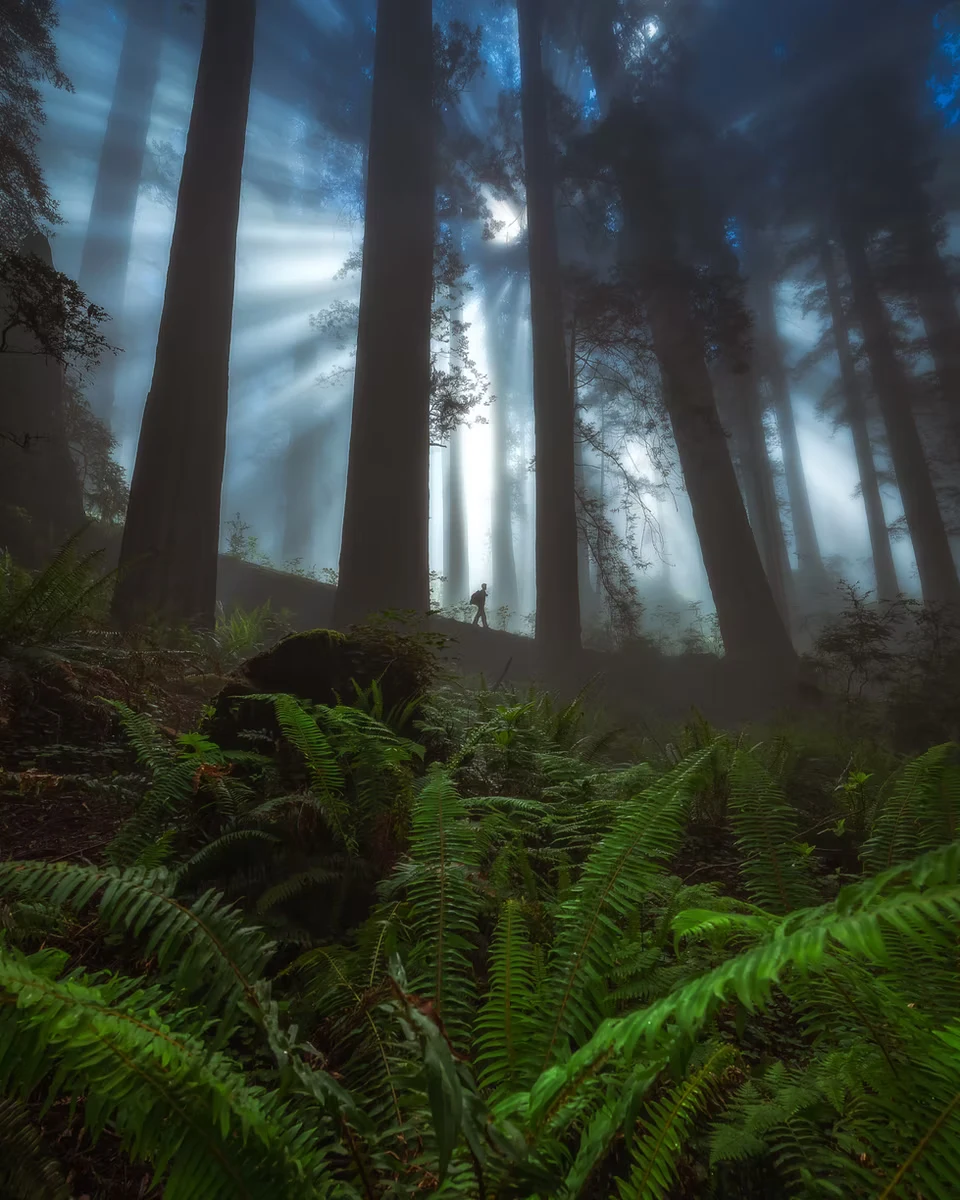
You thought you were looking at the photograph. The photograph was directing you.
Composition is often taught as placement.
Put the subject on a third.
Look for a leading line.
Watch the edges.
Do not let this touch that.
Those ideas can be useful. I still use some of them.
But eventually I became more interested in a different question:
Where will they go?
Not where should I put the subject.
Not which rule should I use.
Where will the viewer's attention actually move?
That changed the way I think about composition because a photograph is not experienced as a collection of objects. It is experienced as a sequence of attention.
Something pulls you into the frame.
Something carries you through it.
Something wins.
Other elements support it.
Eventually your eye settles, leaves the frame or begins moving through it again.
That is the foundation of Visual Pathways.
The five parts of a Visual Pathway
I break that journey into five parts:
- 01Entry
- Where the viewer gets into the photograph.
- 02Movement
- Whatever carries the eye through the frame.
- 03Hero
- What ultimately wins the competition for attention.
- 04Support
- Everything that strengthens the hero, the story or the feeling without overpowering it.
- 05Resolution
- Where the eye settles, exits the frame or begins looping through the photograph again.
These do not have to be five separate objects.
One element can perform more than one job.
And a Hero does not always have to be singular. In some photographs, two elements can share that role.
The point is not to force every photograph into a formula.
The point is to have a language for describing what the viewer is actually experiencing.
A photograph is experienced as a sequence of attention.
A pathway in a real photograph
Look at the sandstone photograph above before reading any further.
Where do you enter?
Where does your eye move?
What wins?
What supports it?
Where do you settle?
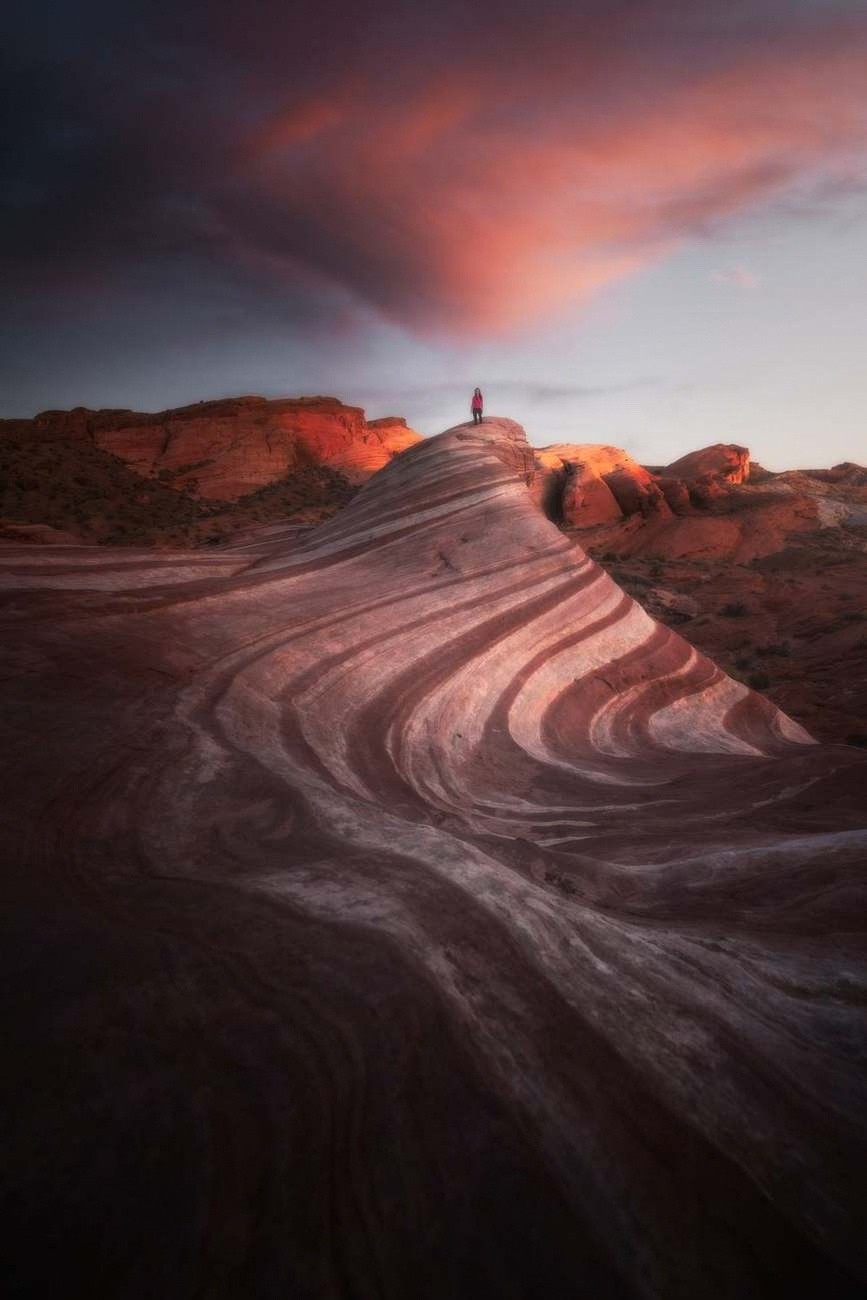
Now look at the same image with the pathway mapped.
- 1Entry
- 2Movement
- 3Hero
- 4Support
- 5Resolution
The Entry begins in the lower-left sandstone striations.
The repeating curved bands create Movement upward through the frame.
The isolated person becomes the Hero.
The illuminated ridge provides Support without overpowering the person.
The eye eventually reaches Resolution in the quieter background on the right.
Nothing about that explanation depends on the rule of thirds.
It depends on attention.
That is the distinction I care about.
A leading line can be part of a Visual Pathway, but a Visual Pathway is larger than a leading line.
A leading line is an object.
A Visual Pathway is an experience.
Some parts of a photograph pull harder than others
Once you start thinking about where the eye moves, another question appears.
Why does one area pull harder than another?
I call that Visual Gravity.
Some parts of a photograph simply have more influence over the eye.
Brightness can pull.
Contrast can pull.
Warm color can pull.
Sharpness can pull.
Isolation can pull.
Scale can pull.
Human presence can pull.
Direction can pull.
And those forces can stack.
A small bright object can have more Visual Gravity than an enormous dark mountain.
That is why the largest thing in the frame is not automatically the most important thing in the frame.
Visual Gravity is relative.
Something becomes powerful because of how it relates to everything around it.
This leads to one of the simplest rules I use when evaluating a photograph:
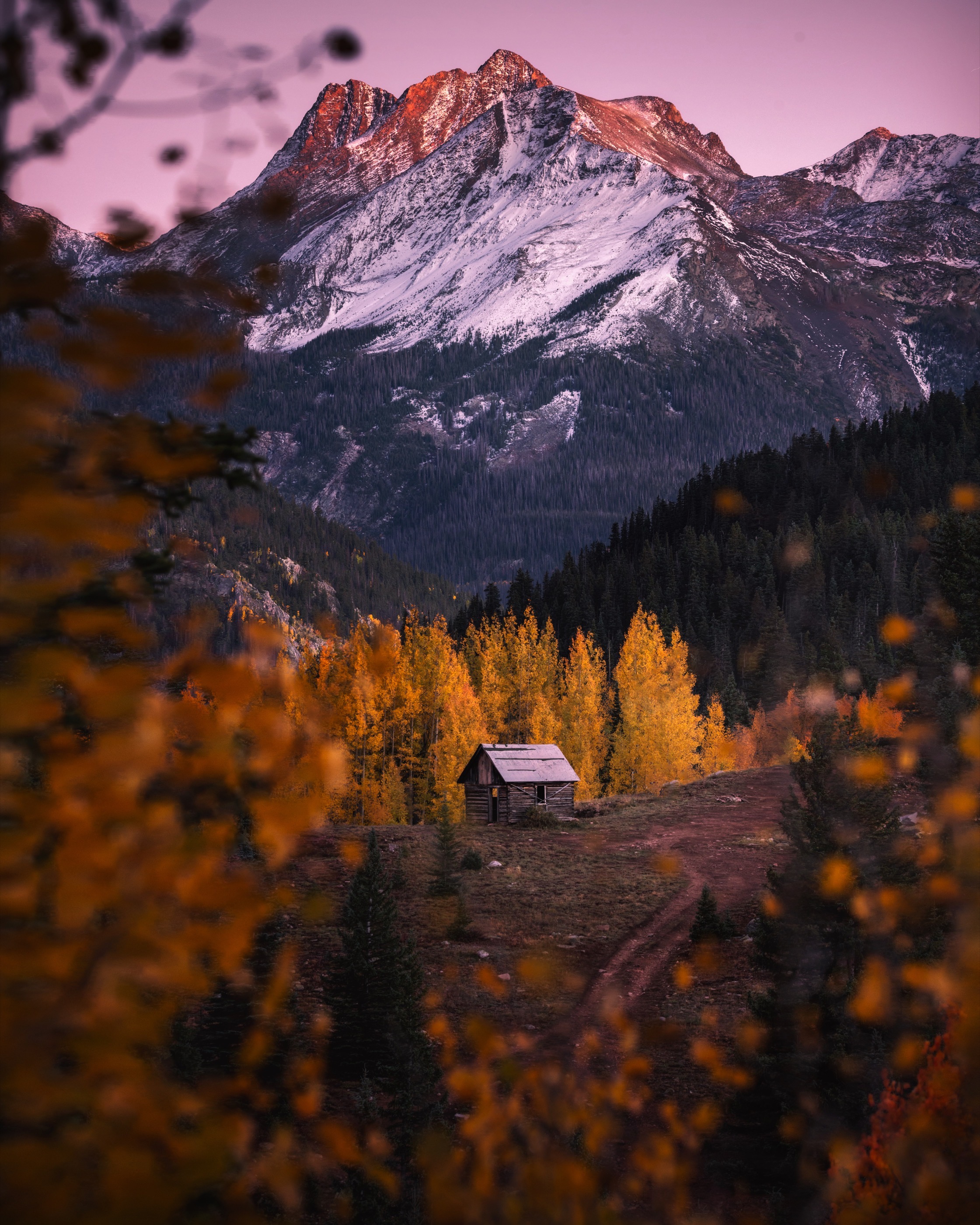
Importance and attention should agree.
If something matters to the photograph, let it pull.
If something is secondary, it should not overpower the Hero.
That is also why I do not love asking only, “Is this distracting?”
Distracting is vague.
A better question is:
Does this element deserve the amount of attention it is receiving?
Not every pathway is a line
Some of the strongest pathways in a photograph are invisible.
They can be created by light.
By atmosphere.
By repetition.
By contrast.
By the gradual loss of detail as the landscape moves into the distance.
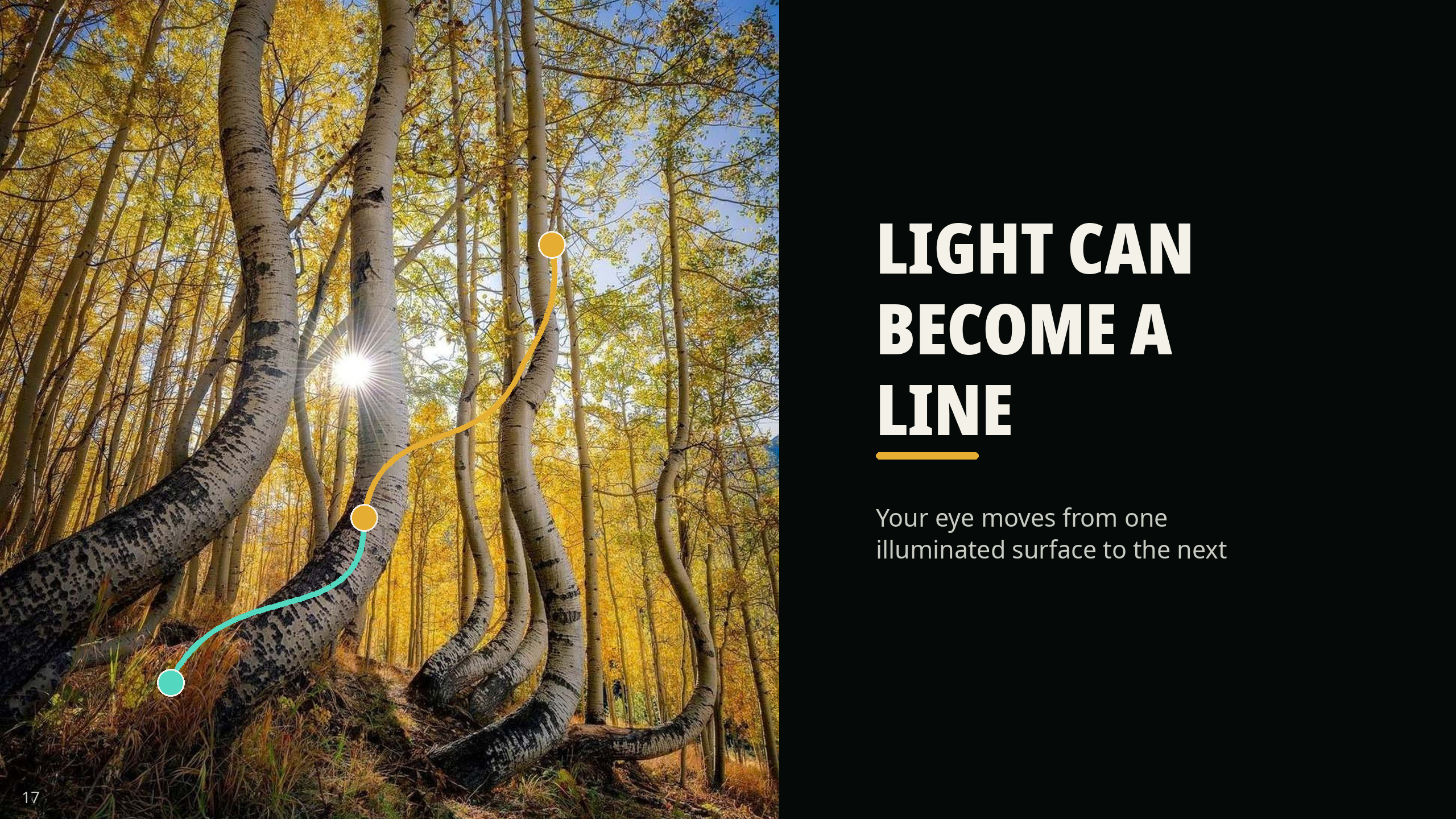
Light itself can become a pathway.
If your eye moves from one illuminated surface to the next, light is not only revealing the composition.
Light is part of the composition.
That changes the question I ask in the field.
Not only:
Where is the light?
But:
Where is the light sending me?
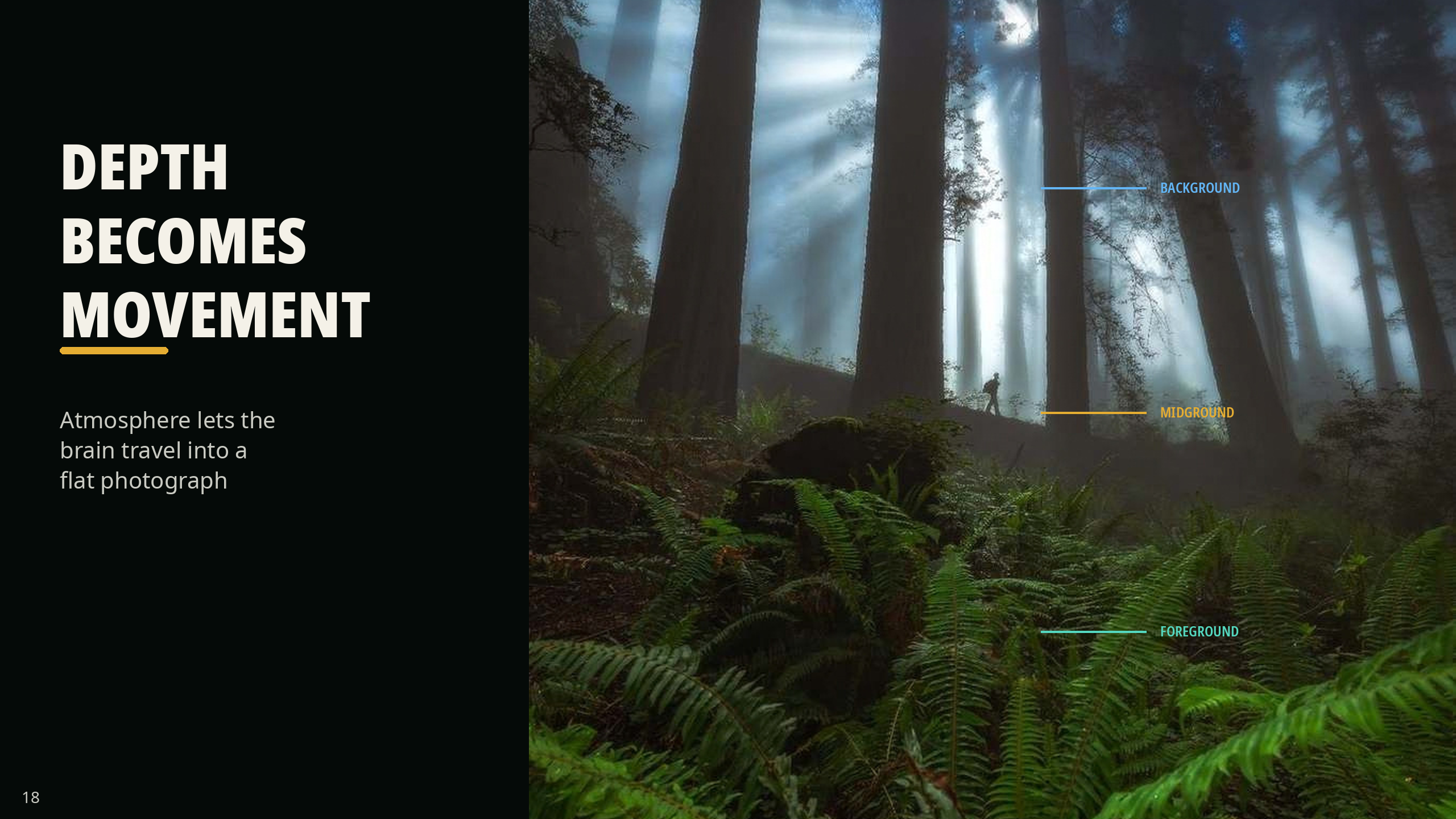
Atmosphere can do something similar.
A detailed foreground can lead into a quieter midground, then into a softer background where contrast and detail gradually disappear.
Your eye is no longer just looking across a flat photograph.
It is moving into it.
Atmosphere turns depth into movement.
Repetition can create rhythm too.
Repeat.
Repeat.
Repeat.
Break.
The pattern creates the pathway.
The interruption creates the payoff.
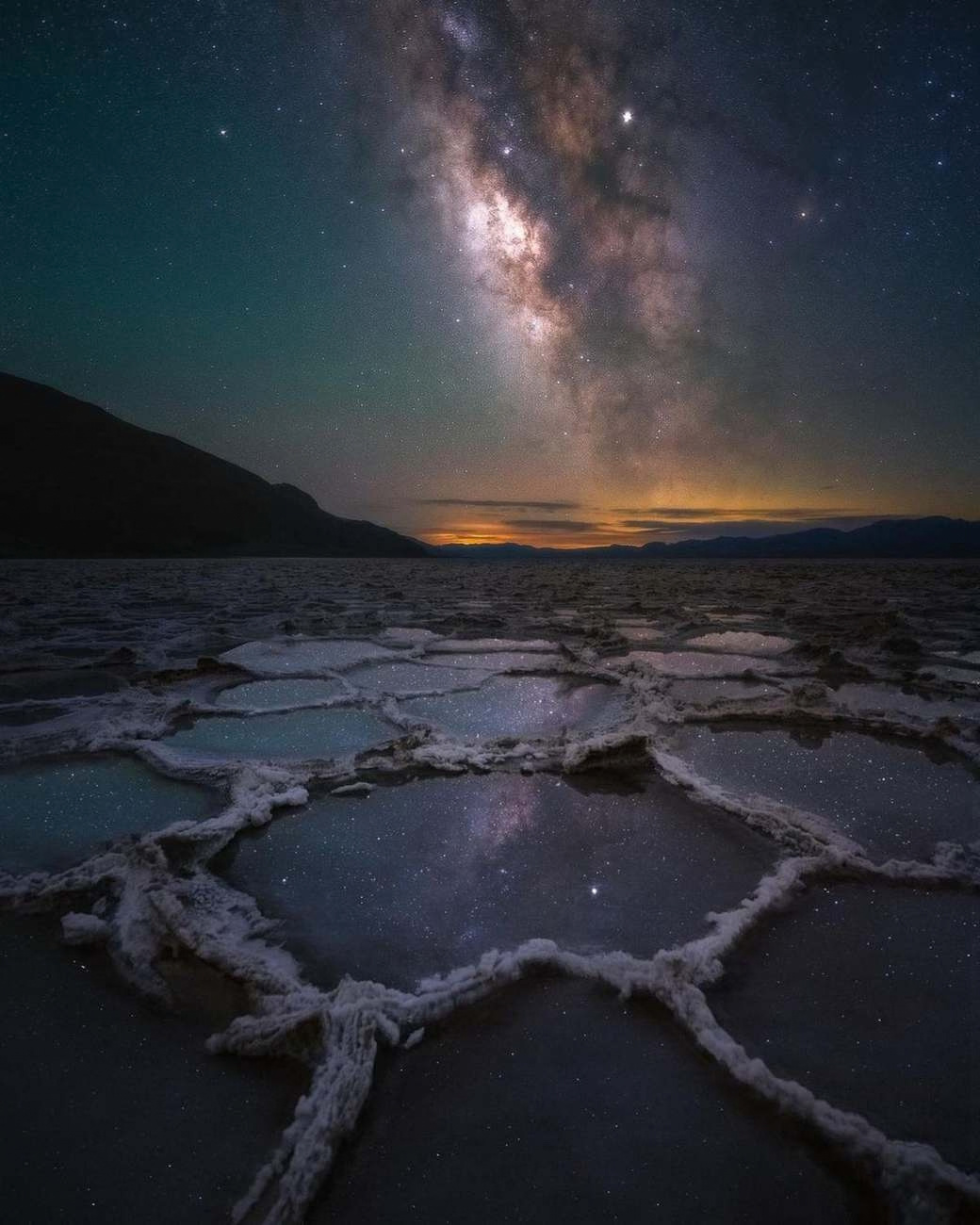
This is why I call it the Invisible Composition.
The viewer can be guided without a road, a river, a fence or any other obvious line.
Composition does not end at the shutter
Visual Pathways also changed the way I think about editing.
If processing changes where the viewer looks, then processing is still composition.
Brightening creates gravity.
Darkening reduces it.
Warmth can pull something forward.
Cooling can push it back.
Sharpening invites inspection.
Softening can reduce competition.
The shutter does not freeze the hierarchy.
You are still shaping it afterward.
My editing process begins with getting the RAW as right as possible in camera, including white balance.
Then I open the file and explore what is there.
What options does the file give me?
What relationships can be developed?
What could this photograph become?
Only after that do I commit to the visual strategy, implement it and polish the result.
That is different from randomly moving sliders until the image looks “better.”
The question is not:
What adjustment should I make?
The better question is:
What is the visual problem I am trying to solve?
And then:
Where should the viewer go?
What is stopping them from getting there?
The most dramatic thing is not automatically the most important thing
Look at this photograph for a few seconds before moving on.
Where do you enter?
Where does your eye move?
What wins?
What supports it?
Where do you resolve?
- 1Entry
- 2Movement
- 3Hero
- 4Support
- 5Resolution
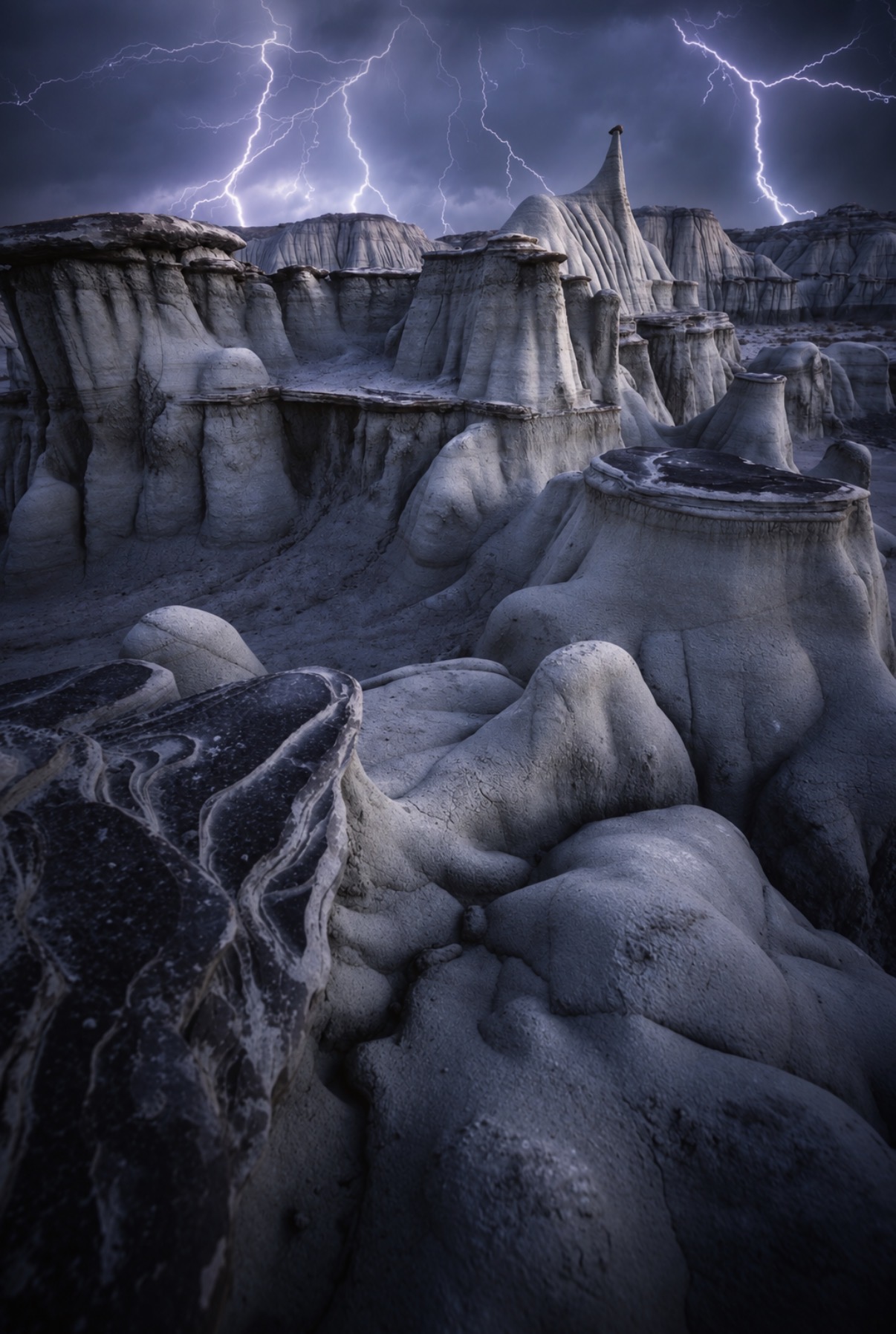
The dark foreground channel creates the Entry.
The repeating rock forms create Movement.
The dinosaur-shaped formation becomes the Hero.
The lightning has enormous Visual Gravity, but it remains Support.
It adds energy.
It adds drama.
It helps reinforce the Hero.
But it does not replace it.
The eye eventually reaches Resolution in the storm-lit basin.
That distinction matters.
The most dramatic thing in the frame is not automatically the most important thing in the frame.
Everything has a job.
The strongest photographs are not simply collections of dramatic elements. The elements have to work together.
The final question
The strongest photographs do not simply show a place.
They create an experience of that place.
As photographers, we are deciding what the viewer will notice, when they will notice it and what they will feel when they arrive. That is where pathway, hierarchy and storytelling come together.
So before worrying about a rule, a slider or a histogram, ask:
Where do I want them to go?
Then ask:
What do I want them to feel when they get there?