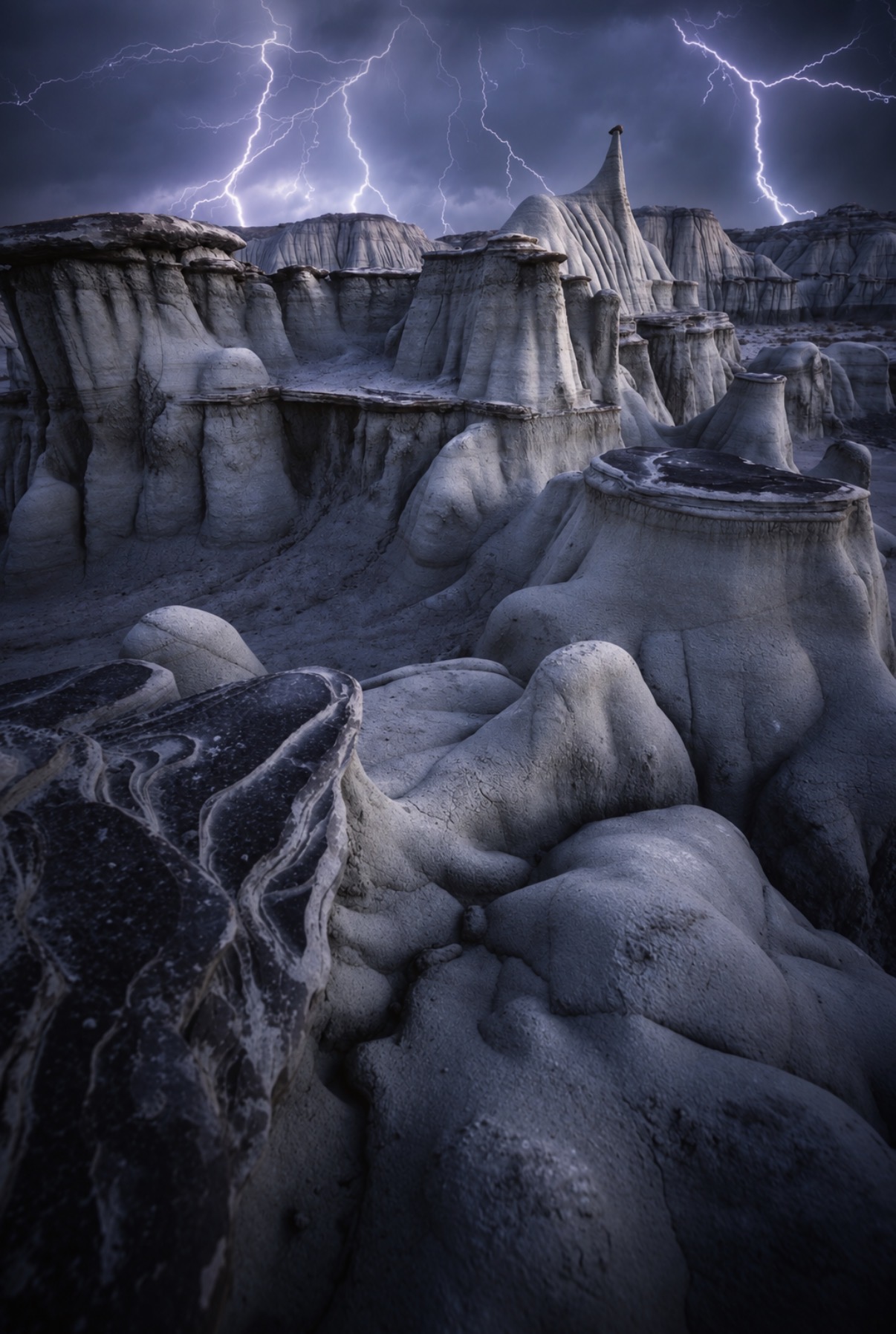
The best decision I made for this photograph was to leave
We were almost a mile into the badlands when lightning flashed close enough that the thunder hit almost immediately.
Everybody jumped.
That was our cue.
We packed up and headed for camp.
Leaving did not mean the photographic opportunity was over. It just changed what the opportunity looked like.
I Didn't Want a Wide Photograph of Lightning
Back at camp, we got dry, everyone set up their cameras facing the storm and started running timelapses while we cooked and ate dinner.
At that point, we all pretty much thought the shoot was over. If the lightning kept going, great. If the clouds broke and the stars came out, that could have made for a pretty cool timelapse too.
Everyone was set up. There was nothing left to teach for the night.
So while the cameras kept running, I decided to risk it for the biscuit.
Instead of staying wide, I grabbed the 150–600mm, went all the way to 300mm and aimed at one section of sky where I thought the storm was most likely to produce.
Then I started running 30-second exposures back to back to back.
I was not watching for a bolt and trying to hit the shutter at exactly the right moment. I was letting the camera continuously make 30-second frames and hoping that eventually one of those exposures would line up with a good strike.
Eventually, one did.
That frame became the lightning photograph in my Sky Bank.
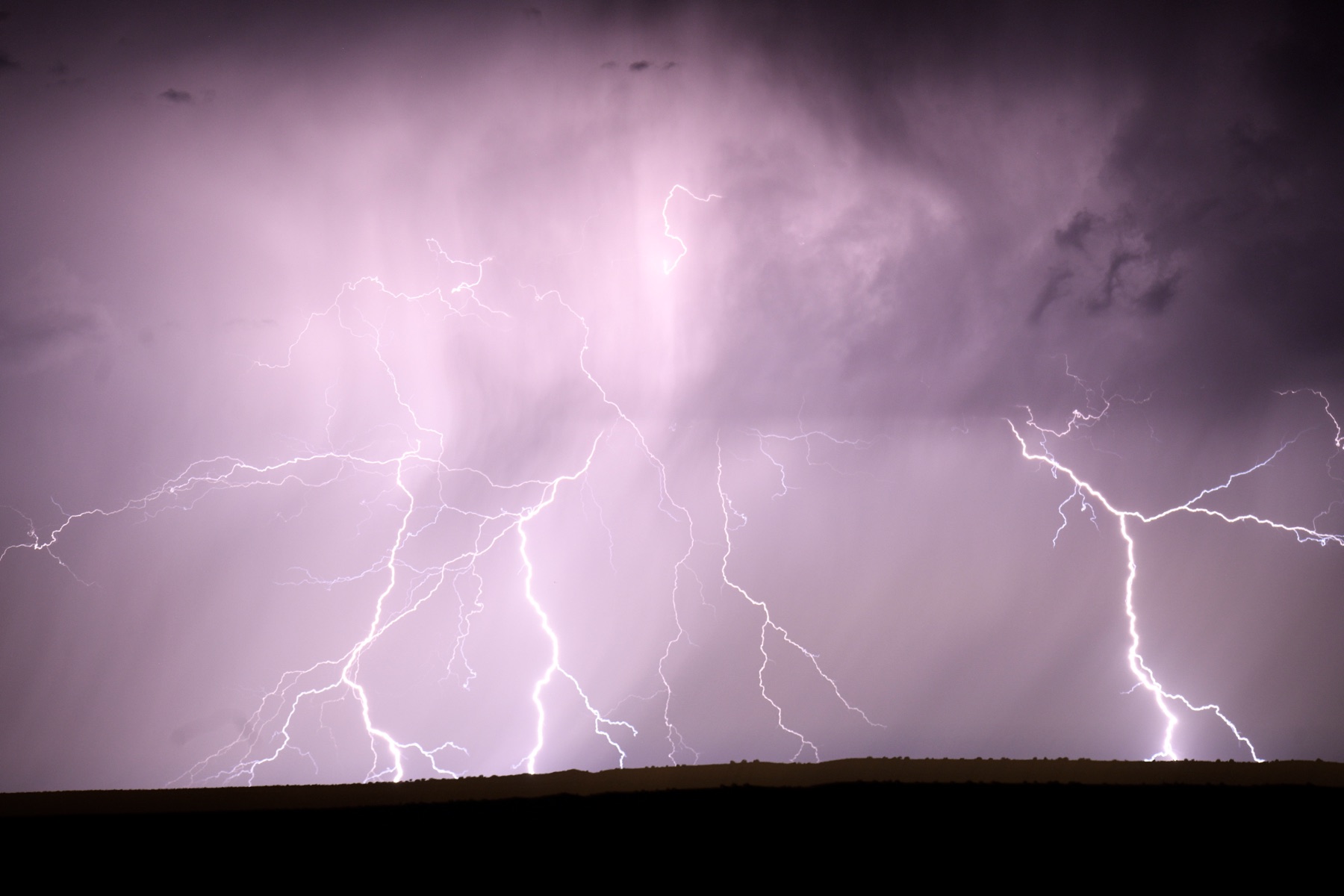
Lightning capture
- Camera
- Nikon D850
- Lens
- 150–600mm
- Focal length
- 300mm
- ISO
- 800
- Aperture
- f/5.6
- Shutter speed
- 30 seconds
The Foreground Belonged to a Student First
The following evening, I was back in the badlands with my workshop group.
We were waiting for the right light at one of the better-known compositions when I did what I always seem to do.
I started looking around.
Even when I am standing somewhere I already know, I am looking for relationships, shapes and visual pathways I have not photographed before.
That is when I noticed this foreground.
But during workshops, I do not shoot for myself.
My job is to teach and make sure my students get the photographs.
So instead of setting up my own camera, I showed the composition to one of my students and let them work it.
Then I saw it on the back of their camera.
And immediately thought:
I need to come back here.
The following evening, after the workshop, I did.
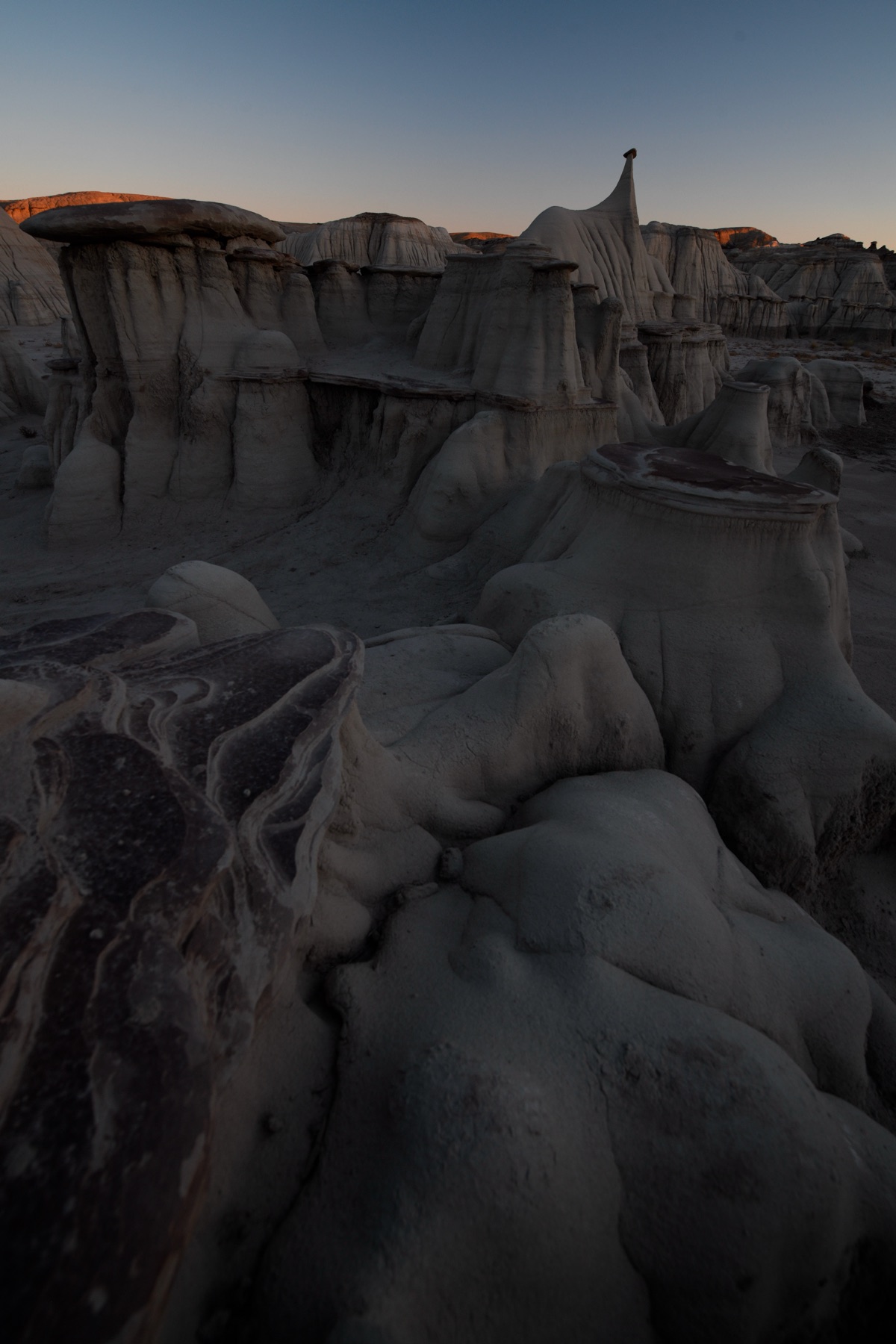
Foreground capture
- Camera
- Nikon D850
- Lens
- AF-S NIKKOR 14–24mm f/2.8G ED
- Focal length
- 14mm
- ISO
- 400
- Aperture
- f/8
- Shutter speed
- 1/50 sec
Why I Didn't Try to Photograph Both at Once
This is where the photograph gets more interesting.
The foreground wanted 14mm.
The lightning wanted 300mm.
Trying to force both into the same exposure would have meant compromising one of them.
At 14mm, the lightning would have been tiny.
At 300mm, I could not have made this foreground.
So instead of asking:
How do I capture everything at once?
I asked:
How do I photograph each part when it can be at its best?
That question changes the possibilities completely.
Build a Sky Bank Before You Need It
When I see a sky worth photographing, I photograph it deliberately.
It does not need an assigned foreground yet.
I collect skies at different focal lengths, in different orientations and across different moods:
Lightning. The Milky Way. Stars. Storms. Mammatus. Lenticular clouds. Moonlit clouds. Partly cloudy night skies. Quiet color.
The goal is not to collect the craziest sky possible and paste it over everything later.
That is usually a pretty good way to ruin a photograph.
The useful question is simpler:
What sky completes this foreground?
The Sky Bank question
Matching Light, Not Merely Color
A convincing composite is not created by simply making everything the same color.
Light has behavior.
Lightning produces a cool violet luminosity. The formations at Bisti absorb and reflect color aggressively, so simply pushing purple into the foreground would make the photograph feel artificial very quickly.
I had to think about what that light would actually do.
Where would it hit? Where would it reflect? Where would it bounce? Which surfaces would catch it? Where would it disappear?
The goal was not to make the foreground purple.
The goal was to make the foreground feel as though it belonged beneath that sky.
Match the behavior of light, not merely the color.
Editing the Visual Path
The lightning is the highest-energy element in the frame.
But I did not want it to become the entire photograph.
The landscape still needed to matter.
So I built the edit around a visual pathway:
Foreground → formations → main hoodoo → lightning → back into the landscape
The foreground gives the eye an entry point.
The formations carry it deeper into the badlands.
The main hoodoo becomes an anchor.
Then the lightning pulls the eye upward.
Atmospheric luminosity and repeating landforms reconnect the sky to the landscape and bring the eye back through the photograph.
That is the difference between simply combining two files and building one photograph.
A composite can be rooted in the real experience of a place without pretending to document one literal moment.
Photograph Each Part When It Can Be at Its Best
I use this same philosophy constantly in my Milky Way work.
I may photograph the foreground during blue hour when there is enough light to carefully build the composition, capture clean detail and get the image quality I want. Then I photograph the Milky Way later when the sky is where I want it.
Each component gets photographed under the conditions that serve it best.
There is another benefit too.
I am not fumbling around in complete darkness trying to discover a composition while the Milky Way is already moving through the frame.
I can arrive early, slow down, walk around, find the relationships and visual pathways I want and perfect the foreground while I can still see it.
Then when the sky arrives, I am ready for it.
Better image quality and a better experience making the photograph are not mutually exclusive.
Capture broadly. Edit intentionally. Disclose clearly.